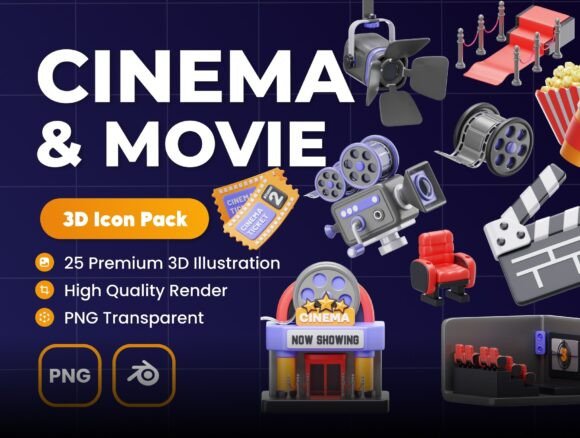
Cinema Movie 3D Illustrations: A Strategic Asset for Modern Design
In the competitive landscape of digital communication, visual differentiation is no longer a luxury; it is a necessity. Cinema Movie 3D Illustrations represent a specific class of high-fidelity assets designed to bridge the gap between flat design and immersive storytelling. Unlike standard stock photography or generic vector icons, these illustrations offer depth, texture, and a cinematic quality that immediately commands attention. For entrepreneurs, marketers, and creative professionals, integrating these elements into your workflow is not merely an aesthetic choice but a strategic decision aimed at enhancing brand perception and user engagement.
The core value of Cinema Movie 3D Illustrations lies in their ability to convey complex ideas with immediate clarity while maintaining a unique visual identity. When you incorporate these assets into web designs, UI interfaces, presentation slides, or marketing posters, you are leveraging a medium that resonates with modern audiences accustomed to high-quality digital experiences. The package typically includes 25 unique 3D icons rendered at a high resolution of 3000 x 3000px, ensuring scalability across various platforms without loss of quality. However, the true strategic advantage comes from understanding how to deploy these resources intentionally to support broader business goals.
Elevating Brand Positioning Through Visual Depth
Branding is the sum of every interaction a customer has with your business, and visual consistency plays a pivotal role in this ecosystem. Many organizations struggle to stand out because they rely on overused templates and generic imagery. Cinema Movie 3D Illustrations provide a distinct alternative by introducing a sense of polish and professionalism that suggests innovation and forward-thinking. When used correctly, these illustrations can transform a standard corporate presentation into a compelling narrative that stakeholders remember long after the meeting ends.
Consider the application of these assets in UI design. In an era where user retention is critical, the interface must feel intuitive yet engaging. Adding unique 3D elements to a dashboard or a landing page can guide the user's eye, highlight key actions, and reduce cognitive load by making abstract concepts tangible. For instance, a fintech startup might use a stylized 3D icon representing security or growth to reinforce trust and stability. This approach goes beyond decoration; it aligns the visual language with the company's core values, creating a cohesive brand experience that supports long-term positioning.
Operational Efficiency and Creative Flexibility
One of the most significant advantages of utilizing a curated set of Cinema Movie 3D Illustrations is the operational efficiency it brings to the design process. Creating high-quality 3D assets from scratch requires specialized skills in software like Blender, significant rendering time, and a deep understanding of lighting and texturing. By accessing a ready-to-render collection of editable objects, teams can bypass the steep learning curve and production bottlenecks associated with custom 3D modeling.
The inclusion of editable objects and colors within the package allows for rapid customization to match specific brand guidelines. This flexibility means that a marketing team can adapt a single asset for multiple campaigns—altering color palettes to fit seasonal themes or modifying object properties to suit different product lines—without needing to commission new work for every iteration. This agility is crucial for small business owners and freelancers who need to maintain a high output volume without compromising on quality. The ability to download high-resolution PNGs ensures that the final output is print-ready for posters or scalable for digital screens, streamlining the entire production pipeline.
Strategic Planning for Implementation
Before integrating Cinema Movie 3D Illustrations into your projects, it is essential to establish clear objectives. Randomly scattering 3D elements across a website or document can lead to visual clutter and dilute the message. A strategic approach involves mapping out where these assets will have the most impact. Ask yourself: Does this illustration clarify a complex data point? Does it evoke the desired emotional response? Does it align with the overall tone of the brand?
Effective planning also involves considering the technical environment. While the assets come as high-resolution files, ensuring that your delivery platform supports them is vital. For web designers, optimizing the file size of these 3000 x 3000px images for faster loading times is a necessary step to prevent negatively affecting user experience. Similarly, for presentation slides, understanding how the 3D depth translates onto different screen sizes and projectors can make the difference between a stunning reveal and a distorted image.
Enhancing Communication and Storytelling
Visuals are a universal language, and 3D illustrations possess a unique capacity to tell stories that static images cannot. In educational contexts, for example, educators can use these assets to visualize abstract theories or historical events, making learning more interactive and memorable. For publishers and bloggers, incorporating Cinema Movie 3D Illustrations can break up walls of text, providing visual anchors that improve readability and keep the audience engaged.
The "cinematic" quality of these illustrations implies a level of drama and focus that can be harnessed for persuasive communication. In sales presentations, using a dynamic 3D graphic to represent a solution can make the value proposition feel more concrete and achievable. It shifts the conversation from theoretical benefits to tangible outcomes. This is particularly effective when addressing decision-makers who need to visualize the end result of a project or investment. The depth and realism provided by these assets help build a mental model of success, facilitating better decision-making among clients and partners.
Risks of Misapplication and Contextual Awareness
While the potential benefits are substantial, there are risks associated with using Cinema Movie 3D Illustrations without a clear strategy. The primary danger lies in style dissonance. If a brand's identity is rooted in minimalism or stark typography, introducing highly detailed, colorful 3D elements can create a jarring contrast that confuses the audience. Consistency is key; the style of the illustrations must complement, not contradict, the existing visual language of the brand.
Furthermore, over-reliance on pre-made assets can sometimes lead to a homogenized look if competitors are using the same libraries. To mitigate this, users should take full advantage of the editable features. Customizing colors, combining multiple icons, or adjusting the perspective can ensure that the final output remains unique to your brand. It is also important to consider accessibility. High-contrast 3D elements must still meet readability standards for users with visual impairments, ensuring that the design enhances inclusivity rather than hindering it.
Decision-Making Guidance for Creators
When deciding whether to invest time in integrating these assets, creators should evaluate the specific needs of the project. Is the goal to inform, entertain, or persuade? If the objective is to showcase technical precision or futuristic innovation, Cinema Movie 3D Illustrations are an ideal choice. However, if the content requires a raw, human connection, traditional photography or hand-drawn sketches might be more appropriate.
The ease of use provided by the Blender PNG format and ready-to-render capabilities lowers the barrier to entry, but it does not remove the need for thoughtful curation. Professionals should view these tools as part of a larger toolkit, selecting them based on their ability to solve specific communication challenges. By treating each illustration as a strategic component rather than just a decorative element, businesses can maximize the return on their creative efforts.
Long-Term Value and Future-Proofing Designs
In the rapidly evolving world of digital media, trends shift quickly. However, the demand for high-quality, three-dimensional content shows no signs of waning. As virtual reality, augmented reality, and spatial computing become more prevalent, the skills and assets associated with 3D design will only grow in importance. Investing in a robust library of Cinema Movie 3D Illustrations now positions your brand to adapt to these emerging technologies more easily.
Moreover, the versatility of these assets ensures long-term utility. A well-designed 3D icon can be repurposed across years of campaigns, updated with new color schemes, or integrated into new mediums as they arise. This longevity provides a cost-effective solution for maintaining a fresh and modern brand image without constantly reinventing the wheel. For freelancers and agencies, having a go-to collection of high-quality 3D elements can significantly speed up client deliverables, allowing more time to focus on strategy and client relationships.
Ultimately, the integration of Cinema Movie 3D Illustrations into your design workflow is about making informed choices that prioritize clarity, engagement, and brand integrity. Whether you are designing a poster, building a website, or preparing a pitch deck, these assets offer a powerful way to enhance your message. By approaching their use with intention and strategic foresight, you can unlock new levels of creativity and achieve superior results in your professional endeavors. Feel free to reach out if you have questions about implementation or customization; the goal is to ensure these tools serve your vision effectively.